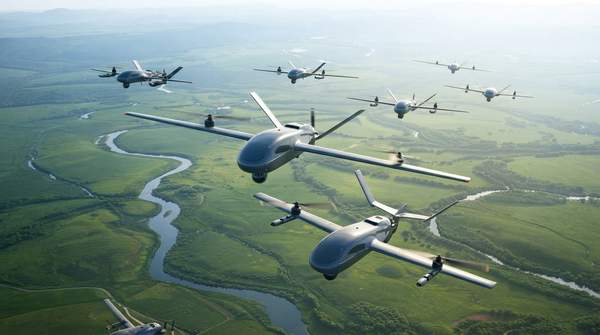
Shield AI Inc.'s Series G funding round valued the company at $12.7 billion, more than doubling its previous valuation, according to J.P. Morgan. The $12.7 billion valuation of Shield AI Inc.'s Series G funding round, more than doubling its previous valuation, reveals a dramatic shift in how private capital views the defense sector, moving beyond traditional government contracts and recognizing the potential for rapid technological advancement. The company's significant valuation establishes a new era of investor confidence in defense technology.
However, this record capital influx into defense technology occurs even as global venture funding is heavily concentrated in a few AI giants. Despite this concentration, defense technology independently attracts substantial capital and achieves significant valuations. The sector carves out its own investment niche, separate from broader tech trends.
Therefore, the defense sector is likely to see accelerated innovation and a more diverse supplier base. This trend could reshape global security landscapes and challenge traditional defense industry incumbents, as agile startups gain market share and influence.
The New Scale of Defense Tech Investment
- $12 billion — Venture capital investment into defense tech has reached this figure, according to Financial Times.
- $19.8 billion — In the first quarter of 2026 alone, venture capitalists deployed a record amount into defense tech across 262 deals, according to Fortune. This figure suggests either the Financial Times' $12 billion refers to a different period or a more specific sub-sector, indicating varying scopes in reporting this rapidly evolving market.
- $510 billion — Global venture funding reached this record amount in the first half of 2026, according to Crunchbase News. While defense tech represents a fraction of this total, its rapid growth and substantial quarterly deployment implies a sustained re-prioritization of national security within private investment portfolios.
Big Deals and Dedicated Funds Emerge
Major financial events confirm the growing maturity of defense tech funding. The €3.8 billion IPO of Czechoslovak Group (CSG) on Euronext Amsterdam was the largest ever defense IPO globally and was multiple times oversubscribed, according to J.P. Morgan. The €3.8 billion IPO of Czechoslovak Group (CSG) on Euronext Amsterdam, the largest ever defense IPO globally and multiple times oversubscribed, confirms the increasing investor appetite for defense technology companies.
| Transaction Type | Company/Fund | Value/Target | Significance |
|---|---|---|---|
| IPO | Czechoslovak Group (CSG) | €3.8 billion | Largest global defense IPO, oversubscribed |
| Acquisition | ARKA Group L.P. | $2.6 billion | Acquired by CACI International Inc. for fast intelligence delivery |
| Fundraising | Stratos Ventures | $50 million (of $80M target) | New VC fund for defense and resilience startups |
Note: Data compiled from J.P. Morgan and CTech reports.
The sale of ARKA Group L.P. to CACI International Inc. for $2.6 billion emphasizes the critical need for fast delivery of actionable intelligence, according to J.P. Morgan. Furthermore, Stratos Ventures has raised $50 million of its planned $80 million target for a new venture capital fund focused on defense and resilience startups, according to CTech. The sale of ARKA Group L.P. to CACI International Inc. for $2.6 billion and Stratos Ventures raising $50 million for a new venture capital fund confirm defense tech attracts not just startup capital but also significant exits and dedicated institutional funds, solidifying a robust and growing ecosystem where investors see clear pathways to liquidity and strategic value.
AI and Deep Tech Fueling the Surge
The surge in defense tech funding is deeply intertwined with the broader explosion in AI and deep tech investment. More than 70% of global startup capital in Q2 2026 was invested in AI-focused companies, according to Crunchbase News. More than 70% of global startup capital in Q2 2026 was invested in AI-focused companies, confirming AI's pervasive influence across the startup ecosystem.
OpenAI and Anthropic alone accounted for $217 billion, or 43% of all startup funding in H1 2026, as reported by Crunchbase News. Despite this significant capital monopolization by a few AI giants, defense technology continues to attract substantial investment. The demand for advanced AI, robotics, and other deep technologies in national security applications drives this independent growth, creating a powerful intersection of innovation and strategic necessity.
New Players Reshaping the Defense Landscape
The influx of private capital and new technologies actively reshapes existing market structures within the defense sector. The rise of companies blurring the lines between commercial and defense sectors illustrates how venture-backed innovation creates new giants. For instance, the largest IPO ever for a venture-backed company and the largest startup acquisition ever both took place in Q2 2026 and involved SpaceX, according to Crunchbase News.
The largest IPO ever for a venture-backed company and the largest startup acquisition ever, both involving SpaceX in Q2 2026, challenge traditional defense contractors and procurement models. Agile, VC-backed startups prove capable of delivering advanced solutions at speeds often unmatched by established incumbents. This shift forces a re-evaluation of how defense capabilities are developed and acquired, favoring innovation and rapid deployment to maintain a competitive edge.
The Path Forward for Defense Innovation
Traditional defense contractors are no longer just competing with agile startups; they are actively consuming them to acquire critical, fast-delivery intelligence capabilities they struggle to build internally.
- ARKA Group L.P. was sold to CACI International Inc. for $2.6 billion, according to J.P. Morgan.
As private capital continues to flow into defense tech, governments must streamline procurement processes. Fostering public-private partnerships will be crucial to fully leverage these rapid advancements. This integration can help maintain a technological edge and ensure national security agencies benefit from private sector innovation, ultimately enhancing global stability.
The defense technology sector, if it maintains its current investment trajectory and continues to attract top-tier talent, will likely emerge as a dominant force in global innovation, potentially redefining national security paradigms and accelerating technological adoption across other critical industries.