A polished video can capture attention. A strategically developed video can do much more.
For businesses competing for attention across television, digital platforms, social media, websites, and other channels, video production has become part of a much larger marketing challenge. The question is no longer simply whether a company can produce something that looks professional. The more important question is whether the content communicates the right idea to the right audience and contributes to a defined business objective.
Oxygen360 approaches video through the combination of media, creative, and production, creating stories designed to capture attention while supporting marketing performance.
The Idea Comes Before the Camera
It is easy to associate video production with cameras, locations, lighting, editing, and post-production. Those elements matter, but they are not where an effective campaign necessarily begins.
The strongest production projects usually begin with a clear understanding of the audience and the purpose behind the content.
Is the campaign introducing a new product? Is it building awareness? Is it supporting a seasonal promotion? Is it changing how people perceive an established brand? Is it designed to encourage prospective customers to investigate a service?
The answer affects virtually every creative decision that follows.
Oxygen360 begins its stated process with discovery, focusing on the brand, audience, and objectives before moving into concept development, production, and post-production.
That sequence helps prevent production from becoming an exercise in creating attractive footage without a clear strategic role.
Storytelling Gives Information a Reason to Be Remembered
People encounter enormous amounts of marketing content every day. A product feature alone may not be enough to earn attention.
Storytelling gives brands another way to communicate.
Rather than presenting a list of facts, a well-developed narrative can show why a product matters, how a service fits into someone's life, or what makes a brand distinctive.
Oxygen360 describes its creative approach as simplifying big ideas into powerful narratives and developing concepts that are single-minded, audience-led, and designed to perform across platforms.
That philosophy is particularly relevant to video because the format gives brands access to visual storytelling, dialogue, sound, music, movement, pacing, performance, and atmosphere.
When these elements are coordinated around one clear idea, the result can communicate more than a conventional sales message.
Production Quality Supports the Story
Technical quality should never replace a good idea. But when the idea is strong, production quality can help deliver it effectively.
Cinematography can establish a mood. Sound can reinforce emotion. Editing can determine pace. Motion design can explain complex information. Visual effects can expand what is possible on screen.
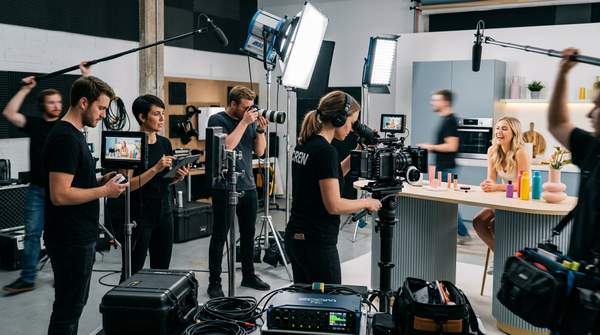
Oxygen360's production capabilities include TVCs and long-form documentaries, supported by 8K edit suites, broadcast-ready audio booths, and motion design and 3D capabilities.
These capabilities matter because different campaigns require different approaches.
A corporate story may require an authentic interview-led treatment. A consumer campaign might depend on fast-paced visual storytelling. A product demonstration may need detailed graphics or 3D elements. A television commercial may require broadcast-ready finishing.
The production approach should serve the concept rather than the other way around.
Why Professional Video Production Can Strengthen a Brand
Audiences form impressions quickly.
A poorly considered advertisement can make a business appear less established than it is. Conversely, carefully produced content can create a more consistent and professional presentation of the brand.
This is particularly important when a video is likely to be seen by prospective customers who have never interacted with the business before.
Video can become an introduction.
It can communicate the personality of a company, demonstrate expertise, present a product, show a location, introduce people behind a business, or make an abstract service easier to understand.
For this reason, production quality is not simply a technical consideration. It can influence how the message is experienced.
One Campaign Can Require Many Versions
Today's audiences encounter content in different environments, and those environments influence how video should be structured.
A campaign created for television may not translate directly into a social feed. A longer brand film may need shorter edits for digital advertising. A product story may require multiple versions designed around different stages of the customer journey.
This makes flexibility important during production.
Oxygen360 identifies platform-specific optimisation as one of its differences, alongside data-informed creative.
Planning for multiple applications from the beginning can make a production project more useful after the initial launch.
Instead of creating one video and deciding later how to use it, marketers can think about the wider content ecosystem during concept development.
That can influence framing, pacing, messaging, aspect ratios, duration, graphics, calls to action, and the way footage is captured.
Video Should Connect With Media Strategy
Production and media should not exist in separate silos.
If a campaign is being developed for multiple channels, the media strategy can influence the content requirements from the beginning. Understanding where the audience will encounter the campaign can help determine how the creative needs to behave.
Oxygen360 combines production with media capabilities across Digital, Programmatic, Social Media, and Total TV. Its media approach also incorporates strategic buying and attribution modelling.
That creates an opportunity to think about content and distribution together.
A video may have one central creative idea, but its expression can be adapted according to the environment in which it appears.
The goal is not to dilute the idea. It is to make the idea work harder.
Measuring What Happens After Launch
The end of production is not necessarily the end of the creative process.
Once content enters the market, audience response can provide useful information. Performance data can reveal where a campaign is gaining traction, where optimisation may be needed, and how different parts of the media strategy are contributing.
Oxygen360 describes its overall approach as measurable and growth-focused, using data-informed creative and media precision as part of its process.
This creates a useful feedback loop.
Instead of viewing a campaign as a fixed piece of content, marketers can consider how the work performs in its real environment and what that performance can teach the business.
That mindset is especially valuable for brands running ongoing campaigns rather than one-off advertisements.
Video Can Support More Than Awareness
Video is sometimes treated primarily as an awareness tool. But its applications can extend much further.
A video can introduce a product to a prospective customer, demonstrate how something works, explain a complex service, provide proof of expertise, reinforce brand positioning, or support a promotional campaign.
Different content can serve different stages of the customer journey.
A broad brand film may create initial familiarity. Shorter product-focused content can provide more detail. Testimonial or demonstration content can address questions. Retargeting creative can encourage someone who has already shown interest to take another step.
The important consideration is having a reason for each asset.
The Difference Is Strategy, Not Just Equipment
Businesses choosing a video production partner should certainly examine production capabilities. But equipment alone does not determine whether a campaign will succeed.
A more useful assessment considers the entire process.
How does the agency understand the audience? How are concepts developed? How does creative connect to the brand's objectives? Can the team handle complex production requirements? Can content be adapted for different platforms? How does media fit into the campaign? What happens after launch?
Oxygen360's model connects these questions through media, creative, and production, supported by an established discovery-to-post-production process.
That integrated perspective allows video to be treated as part of marketing strategy rather than an isolated deliverable.
For businesses investing in professional video production, the distinction matters.
A great-looking video may win a few seconds of attention. A strategically developed production can give that attention somewhere meaningful to go.
And when creative storytelling, production expertise, media distribution, and audience insight are working together, video becomes more than content.
It becomes a business tool.